WHEN THE EQUIPMENT SETS THE LIMITS, AND HOW TO MOVE PAST THEM
Process development rarely runs in a straight line. Cell expansion yields shift between stages, dose targets move, and a wash step gets added after the first tech transfer conversation. Source material varies by patient in autologous programs and by donor in allogeneic ones, and it can change mid-program. A good process has been changed many times in PD on its way to GMP.
Most processing equipment wasn’t built for that. It runs fixed protocols, and when a protocol doesn’t fit, the process bends to fit the tool. Often the constraint isn’t the hardware. It’s the recipe.
The hidden cost of fixed protocols
When a step can’t flex, teams work around it: a manual step at the bench, opening the system to do something the protocol doesn’t allow, or a second device with its own qualification, training, SOPs and consumables, or a compromise that’s close enough.
None of these feels like a big decision at the time. However, each adds a handoff, an operator-dependent step or an open-system risk, and each adds run-to-run variability. A process built on workarounds is harder to document, transfer and defend to quality. The shortcut that was manageable in a lab can become a deviation risk in manufacturing.
What PD teams should expect from a processing platform
We’d suggest five things to hold any platform to, ours included:
- Control over each step’s parameters. Speed, flow, volume and timing should be settings you choose, not values fixed in a protocol.
- Freedom to set the sequence. A wash may need to run three times. The final volume may need to change from run to run.
- One closed system across steps. Every transfer between devices puts the cells, hold-up volume and the batch at risk.
- Room to change scale without changing platforms. Optimization or a low yield can mean running smaller or larger volumes. Neither should mean new equipment.
- A recipe that carries into GMP. What you build in the lab should be what runs in manufacturing.
Modular recipes on UniFuge Mini
The UniFuge Mini (UFMini) is a closed, low-shear, continuous centrifugation platform used from process development through commercial supply, with no cell-count minimum or maximum. Its modular recipe management system extends that flexibility to how the process itself is designed and executed.
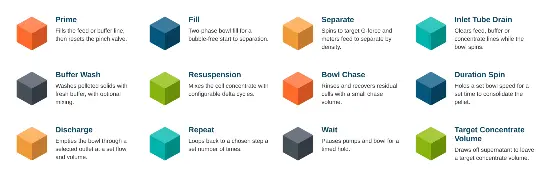
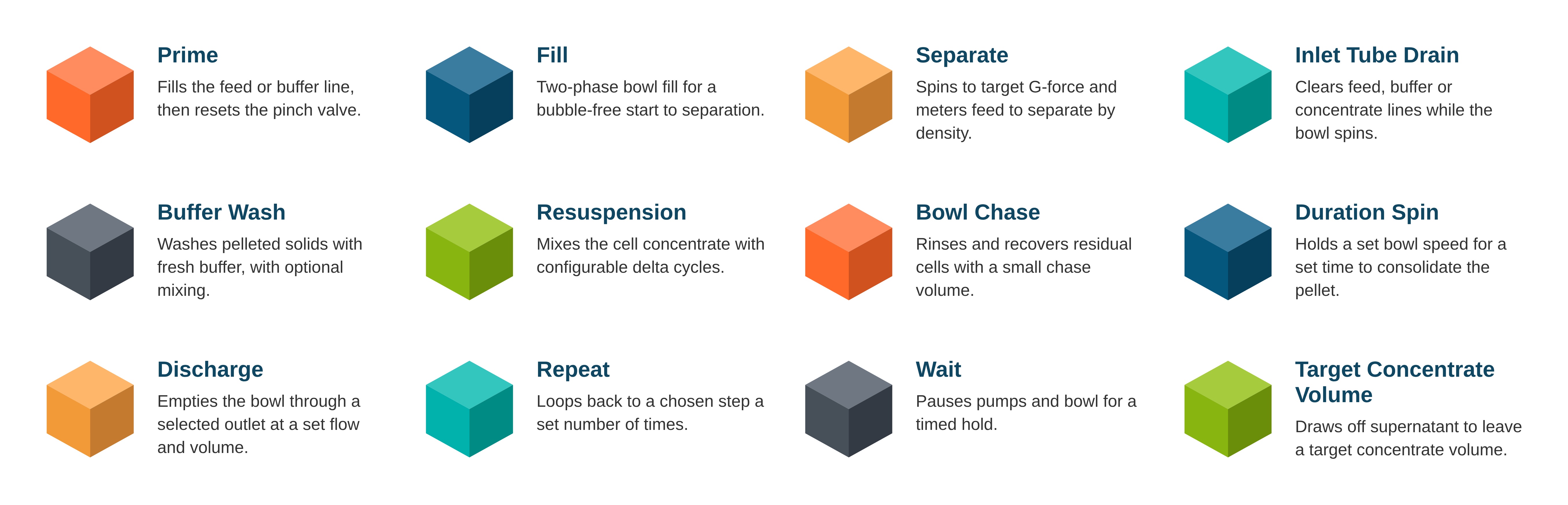
Instead of choosing from fixed protocols, scientists build recipes from configurable functions such as Separation, Buffer Wash and Resuspension as seen in Figure 1. You set the parameters, arrange functions in any order and repeat them as needed. Once built, the recipe runs push-button and walk-away. Recipes can be duplicated and saved as separate versions, so you can test a variation without losing the one that works.

Figure 1: Functions for recipe flexibility: the twelve configurable building blocks behind every recipe.
Changing the process becomes a recipe edit, not a hardware change. The same system covers media exchange, harvest, concentration, wash and pre-formulation, including cryoprotectant addition with example workflows shown in Figure 2. You also don’t build alone: the CARR team works alongside PD teams to develop and optimize recipes as goals change.
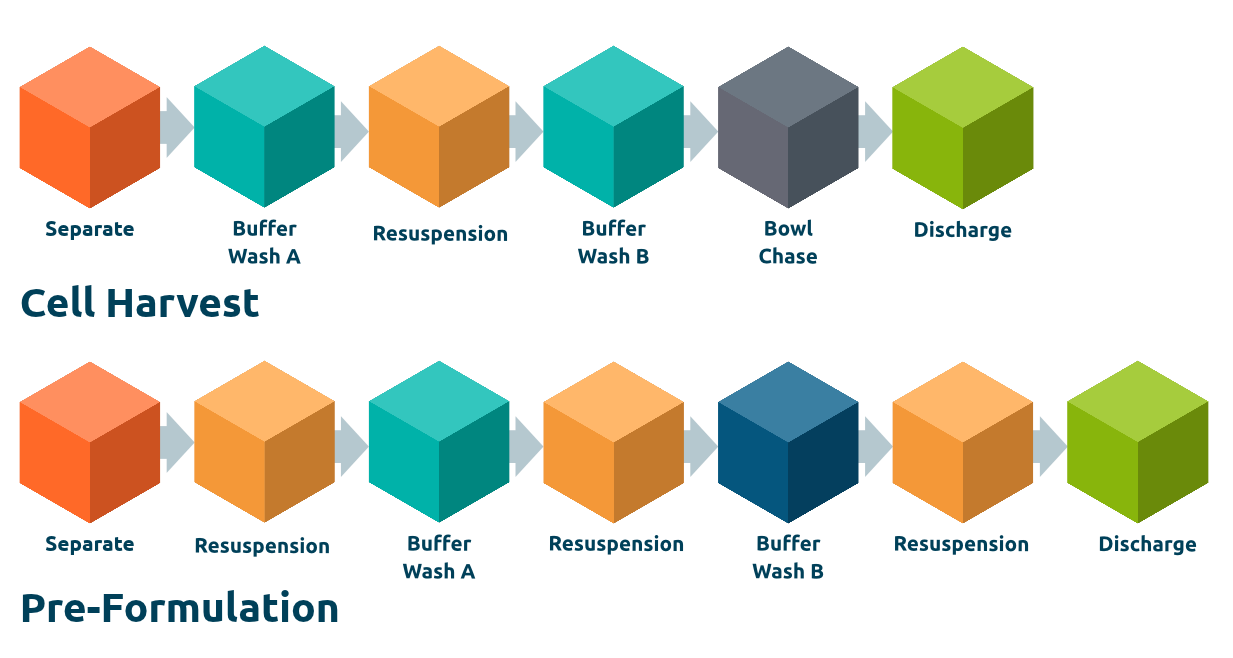
Figure 2: Two recipes, one set of functions: a cell harvest recipe and a pre-formulation recipe with two sequential buffer washes.
What that looks like in practice
One run from harvest to pre-formulation. Harvest, concentration, wash and cryoprotectant addition are often optimized separately, sometimes on separate systems. With modular recipes, they can be tied into a single closed run. For allogeneic programs heading toward a cryopreserved product, that means one defined, repeatable process.
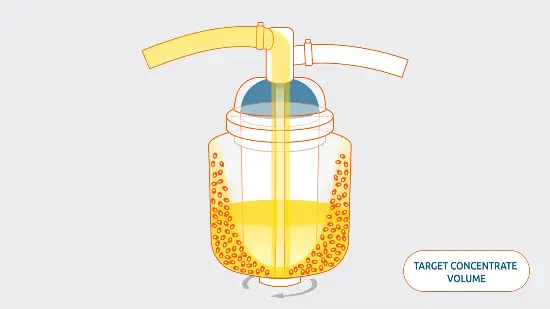
Final volume set by the dose, not the device. The UFMini is recommended for bioreactor or cell culture working volumes from 300 mL to over 25 L. With Target Concentrate Volume (TCV), you set the final concentrate volume, down to 50 mL,* to reach your target concentration, and adjust it from run to run when patient material or an upstream step delivers more or fewer cells than planned. Learn more about TCV in this article.
A defined start to autologous processes. Washing a leukopak on a closed system, with volumes set in the recipe, makes the first step repeatable even when the source material isn’t.
Scale that moves both ways. Scale up as the process matures, or scale back down to save media during optimization or when yield comes in low. Either way, it’s a recipe edit on the same system.
Bench to GMP. The recipe software is 21 CFR Part 11 compliant, and the closed, single-use system is designed for GMP cleanrooms with no biosafety cabinet required.
Already running your UFMini?
Modular recipes and TCV come to existing systems through an upgrade installed during a field service visit. Your CARR representative can walk you through what that looks like for your equipment.
Designing processes, not working around them
Every PD team knows the pull of a workaround. Each one is reasonable at the time. Together, they shape the process more than anyone intended. Process development needs equipment that adapts with the process, from the first PD run through GMP. Modular recipes put that control back with the people developing the process.
See how modular recipes and TCV can fit your workflow → Learn More
* Target performance. Performance is process-condition dependent.