Lentiviral vectors (LVVs) power today’s ex vivo therapies, like CAR-T and stem cell treatments, and they’re driving the next wave of in vivo gene therapies. More than half of gene therapy trials now utilize LVVs, with demand increasing by nearly 20% each year.
Yet manufacturing hasn’t kept pace. Clarification is still inefficient and costly, with conventional depth filtration stacks trapping product, consuming buffers, and lengthening in-suite time. The field urgently needs a closed, single-use platform that preserves yield and consistency from early development through GMP production.
The Bottleneck: Yield loss and cost that hold lentiviral manufacturing back
Too much of the investment to increase upstream lentiviral vector yield is lost during clarification. Depth filtration can result in a loss of up to 20% of the vector produced during harvest. That’s weeks of upstream work — cell growth, transfection, culture, and monitoring — lost at the clarification step.
Even without the extreme cell densities seen in CHO processes, filtration in HEK cultures is inherently inefficient. Filter trains still require cartridge storage, a labor-intensive setup, and extensive flushing during both preparation and recovery. The result is more materials to stage and handle, more labor, and more footprint in the suite.
The ripple effects are significant:
Storage and transfer: QA receiving and incoming inspection, warehousing, staging in intermediate storage, and material ingress procedures (including wipe-down for transfer through air locks).
Setup: unpacking, loading into holders, and pre-flushing with large volumes of WFI and buffer.
In-process: operating oversized filter trains and buffer chases to recover product.
Teardown and disposal: sanitizing with NaOH, flushing caustics, reducing liquid waste by blow-down, and disposing of heavy, wet cartridges, all while maintaining cleanroom standards and ISO class.
Documentation and traceability: logging each filter’s lot number, expiration date, and sterilization status, and recording these details in batch records — a significant workload for operations and QA.
It’s no surprise that companies across the field call lentiviral manufacturing costly and inefficient. The harvest step, meant to be routine, has become one of the most persistent bottlenecks in scaling these therapies. Centrifugation offers a path out of this cycle.
The UniFuge® solution: Low-shear centrifugation made practical
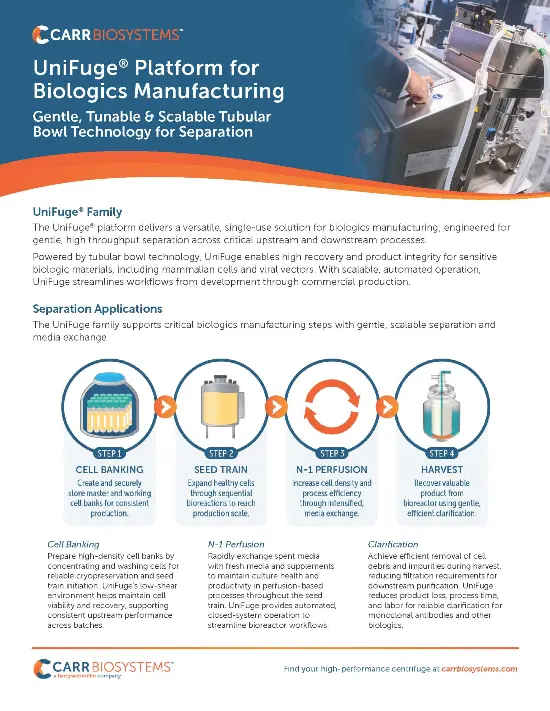
Depth filters aren’t the only option. Centrifugation offers a scalable path that protects fragile viral particles while easing downstream operations. Low-shear forces preserve viral integrity, leading to higher recovery, cleaner outputs, and less burden on chromatography columns.
UniFuge® makes this practical. It delivers consistent performance from small-scale R&D to GMP runs above 200 liters, with the same bowl design and control logic carried across models. Systems are plug-and-play with upstream bioreactors and downstream purification, ready to run in under 15 minutes. Automation reduces manual oversight, and single-use bowls remove cleaning and validation burdens.
The advantages are clear:
Higher recovery (>90%) — more usable vector from every batch.
Reduced filter burden — smaller trains, less buffer, lower labor, and less waste.
Cleaner downstream — fewer impurities carried into chromatography.
Faster turnaround — shorter setup and teardown to free capacity.
Automation and reproducibility — standardized execution across operators and sites.
Seamless scalability — one platform family from R&D to GMP.
By combining performance, simplicity, and scalability, UniFuge turns clarification in lentiviral vector manufacturing from a bottleneck into an operational strength.
Real-world impact: higher yields across programs and partners
The benefits of higher recovery and operational complexities extend across the ecosystem of lentiviral manufacturing.
For cell therapy developers
Closed, automated harvest supports CAR-T and other gene delivery programs by reducing consumables, shortening cleanroom time, and delivering reproducible vectors at lower cost.
For gene therapy producers
High-yield clarification makes otherwise impractical in vivo dosing strategies possible, enabling more therapies to reach patients without the prohibitive burden of oversized production runs.
For CDMOs
Standardized single-use modules and recipe-driven logic simplify onboarding across multiple client programs, streamlining operations and reducing the time and labor required to bring new customers online.
Across each group, UniFuge helps shift lentiviral manufacturing from a fragile process to one that is scalable, consistent, and easier to run.
Scaling lentiviral manufacturing without compromise
Clarification has been a hidden bottleneck in lentiviral manufacturing. Yield losses, heavy filter use, and long process times drain value from every batch and make it harder to meet demand.
UniFuge removes those limits. It gives teams confidence to scale from 100 mL research runs to commercial production above 200 liters, without the setbacks of rework, yield drop-off, or tech transfer headaches.
And while the most urgent need today is in ex vivo therapies like CAR-T and HSC programs, UniFuge also provides a foundation for the in vivo applications that are rapidly approaching. By adopting a scalable, closed platform now, manufacturers position themselves not just for today’s challenges in GMP lentivirus production, but for the therapies that will define tomorrow.
Learn how UniFuge® streamlines lentiviral clarification with higher recovery and simplified operations.